Teaching Yoga on YouTube? Here's What I Wish More Teachers Knew
When I started teaching yoga on YouTube in 2021, I wasn't trying to become a YouTuber.
I wanted to teach yoga.
I also wanted a place where I could teach the kind of yoga I felt called to teach—and where my family and friends, who lived in different places, could join me online.
That distinction matters.
In a yoga studio, there are schedules, class lengths, styles and expectations. You might be hired to teach a 60-minute Vinyasa class at 5:30 p.m. That's the container you've been given.
Online, I discovered something completely different.
I could teach a 20-minute practice because I felt like 20 minutes was enough. I could teach Kundalini. Vinyasa. Strength. Meditation. Philosophy. I could explore an idea simply because I believed someone might need it.
Eventually, I moved from uploading recorded classes to livestreaming classes. And something happened that I didn't expect:
I fell in love with teaching online.
Not only yoga classes, but eventually yoga teacher trainings too.
Students have told me that learning online has been a gift to them. It removes geography. It gives people more flexibility. It allows students who might never walk into the same physical studio to practice and learn together.
Teaching online also gave me something.
It gave me room to become the teacher I am.
I could experiment. Practice. Teach. Learn. Adjust. Teach again.
There was no studio owner deciding whether enough people had signed up for my class. I didn't have to cancel because only one person showed up.
That belief eventually became part of the foundation of Yogi Institute:
A training never gets cancelled.
If one person shows up, we teach.
Because one person matters.
And if one person's life was positively affected by one of the 487 videos I've put on YouTube, I don't consider that time wasted.
I still don't.
But there is an important difference between using YouTube to teach and building a business that makes money from YouTube.
If you're considering starting a yoga YouTube channel because someone told you it's an easy way to make money as a yoga teacher, there's another side of the story you need to know.
I Have Uploaded 487 Videos. My Channel Still Isn't Monetized And I Still Have Very Little Control Over Ads During My Content
I think my own numbers give some helpful perspective. Since starting in 2021, my YouTube channel has generated:
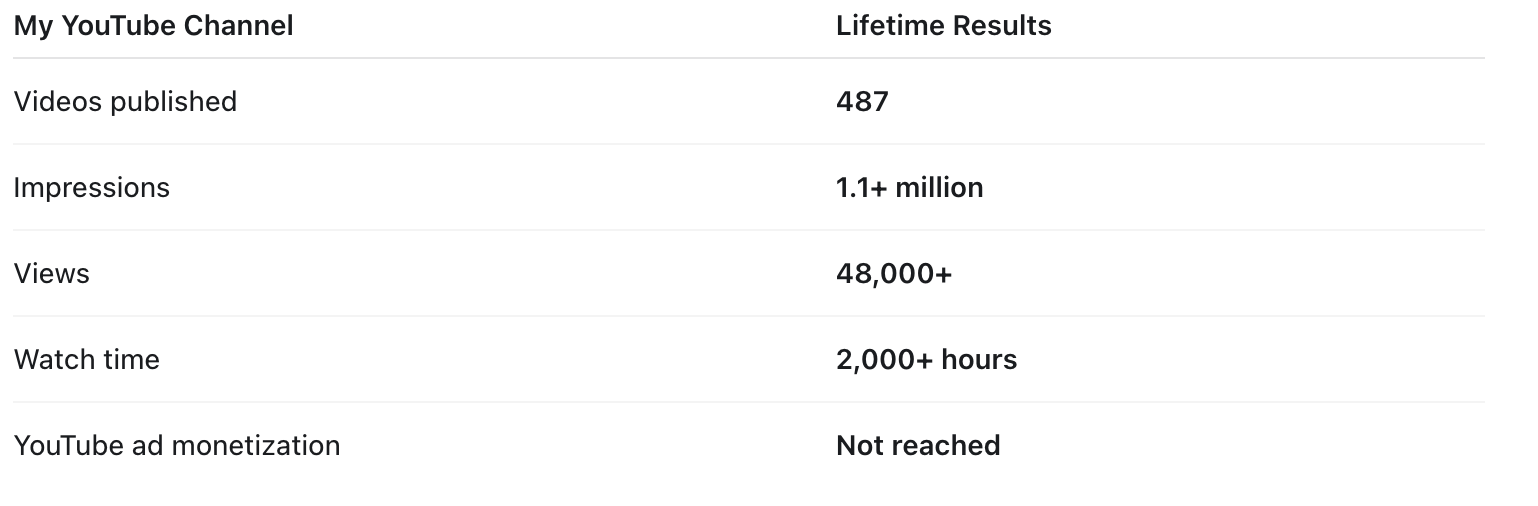
Read that again. 487 videos.
More than 1.1 million times that YouTube has shown one of my thumbnails to someone.
More than 48,000 views.
More than 2,000 hours spent watching my content.
And the channel has never reached the requirements for full YouTube ad monetization.
I don't share these numbers because I consider the channel unsuccessful. Quite the opposite.
People practiced yoga because those videos existed. I became a better teacher—in person and online—because those videos existed. Students discovered my teaching because those videos existed.
I learned how to teach to a camera. I learned how to livestream. I learned how to explain movement without standing beside someone. And I learned that it really is possible to create connection through a screen.
The channel had value. It just didn't have the kind of financial value we're often told a YouTube channel will eventually have.
That's an important difference.
So, How Hard Is It to Make Money on YouTube?
Let's make this very simple.
YouTube has something called the YouTube Partner Program, or YPP.
Think of it like a door.
Anyone can create videos and put them on YouTube without going through that door. But if you want YouTube to share regular advertising revenue from those videos with you, you have to qualify to get through it.
And that door is getting harder for new creators to open.
Today, full ad and YouTube Premium revenue sharing generally requires 1,000 subscribers plus either 4,000 valid public watch hours within the previous 365 days or 10 million valid public Shorts views within 90 days. See YouTube's current YPP requirements
Beginning February 1, 2027, YouTube is doubling the watch-time and Shorts requirements for new creators seeking full ad monetization: 8,000 qualified watch hours within 365 days or 20 million qualified Shorts views within 90 days.The subscriber requirement remains 1,000.
Creators who are already in the YouTube Partner Program aren't subject to the new entry threshold. Read YouTube's 2027 YPP announcement
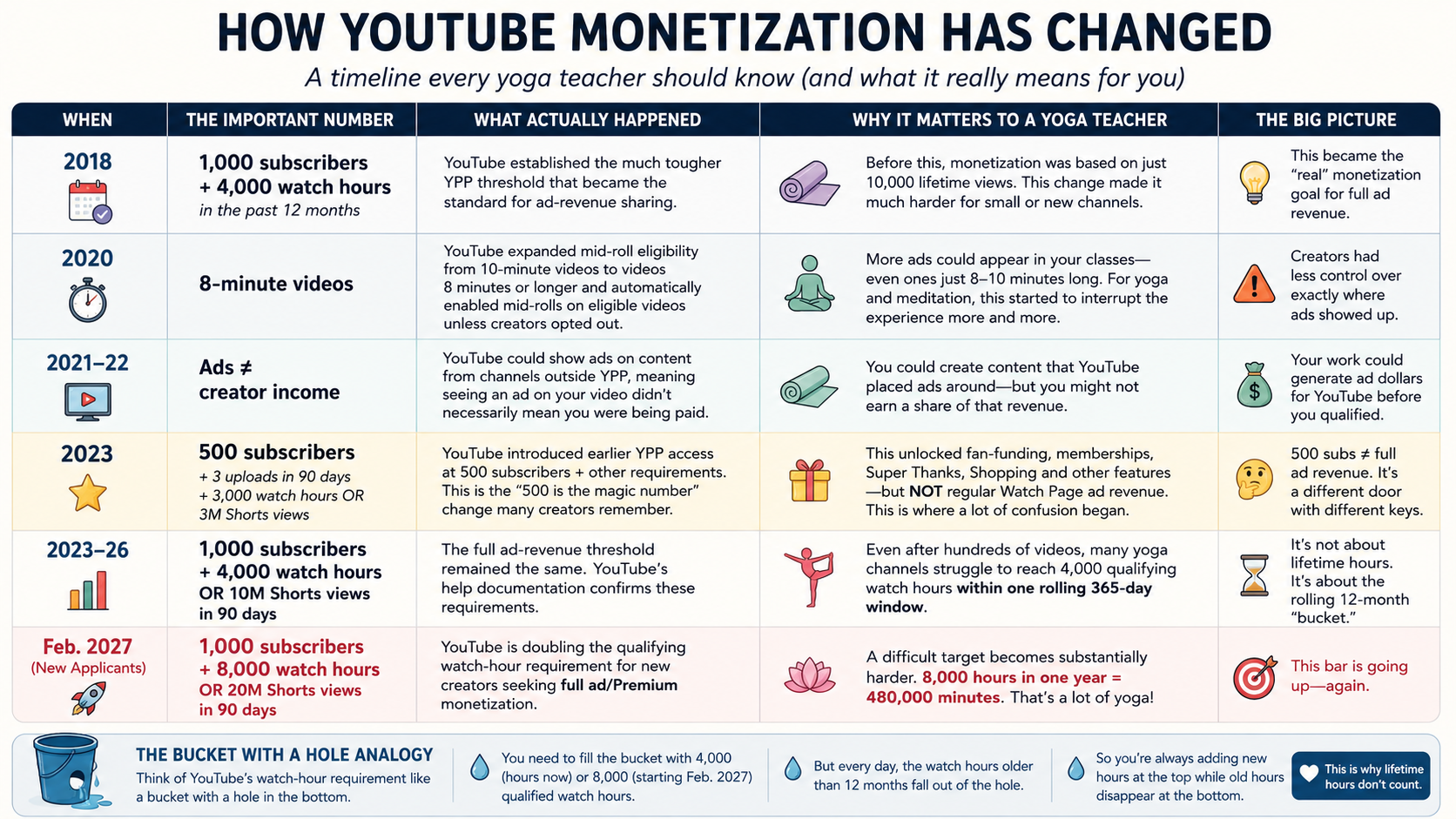
How YouTube Monetization Has Changed
[Insert your YouTube monetization timeline chart here]
I would have loved for my YouTube channel to become monetized.
Of course I would.
I was putting an enormous amount of time and energy into creating free yoga classes, and being paid for that work would have been wonderful.
For a while, 500 subscribers felt like the magic number I was working toward.
If you were following creator news around 2023, you may remember hearing that YouTube had lowered its Partner Program requirement to 500 subscribers.
Here's where it got confusing.
There were essentially two doors.
The first door opened at 500 subscribers, along with additional requirements. Qualifying creators could get access to some ways of making money, including memberships, Super Thanks and Shopping.
But that wasn't the same door that gave you regular advertising revenue from people watching your videos.
For that, you still needed 1,000 subscribers plus 4,000 valid public watch hours within the previous 365 days, or the Shorts alternative. See YouTube's explanation of the two YPP levels
That distinction matters.
Because when someone says:
“You can monetize YouTube with only 500 subscribers!”
A new creator could reasonably think:
Great. Once I reach 500 subscribers, YouTube will start paying me for the views on my videos.
That's not what it meant.
And then there are the watch hours.
Those are even easier to misunderstand.
Think of Your Watch Hours Like a Bucket With a Hole in It
Imagine you need to fill a bucket with 4,000 watch hours.
You start pouring hours into the top.
100 hours.
500 hours.
1,000 hours.
2,000 hours.
But there's a hole in the bottom.
You don't get forever to fill your bucket. Once qualifying watch hours become more than a year old, they no longer count toward that rolling 365-day requirement.
So you're continually adding new hours at the top while older hours are dropping out of the bottom.
You aren't trying to reach 4,000 watch hours eventually. You're trying to have 4,000 qualifying watch hours inside the bucket at the same time.
And beginning February 1, 2027, new creators seeking full ad monetization won't need to fill that bucket with 4,000 hours.
They'll need 8,000.
Or they'll need to reach 20 million qualified Shorts views in 90 days, while also meeting the subscriber requirement. Read more about the new requirements
That's a very different picture from simply being told:
“Stay consistent and eventually you'll get monetized.”
The Final Straw for Me Wasn't Monetization. It Was the Student Experience.
I want to be clear about something. I would have loved to monetize my YouTube channel. I had created hundreds of classes. People were watching them. I was putting real time, energy and money into creating free yoga content. Getting paid for that work would have been wonderful. But not being monetized wasn't ultimately why I stopped focusing on full-length YouTube classes.
The ads were. At some point, I began noticing more and more advertisements appearing throughout my classes. And because my channel wasn't monetized, I didn't have the kind of control over that advertising experience that I wanted.
This became my final straw. Imagine taking a yoga class. You've spent the first three to five minutes getting present with the teacher. Your breathing has slowed. Your nervous system is settling. I'm intentionally creating the energy and environment for the class. Maybe you're finally still. Maybe you're enjoying moving freely within your body.
And then... An advertisement starts. Not one I or you chose. Not at a place in the class I chose. Not because I thought an advertisement would serve you in that moment. It could be hemorrhoid cream. Tampons. An audiobook. A car. Insurance. Anything. For me, this wasn't simply annoying. It changed the experience I was trying to create.
I couldn't reconcile asking someone to turn inward while knowing an advertisement might suddenly pull them back out. And perhaps the most frustrating part was that my channel wasn't receiving the advertising revenue anyway. I had created the class. I had taught it. I had filmed it. I had uploaded it. My student had chosen to practice with me. Yet I couldn't fully control the space between us.
That's when I realized something important: YouTube could host my yoga class, but it couldn't necessarily protect the experience I wanted my students to have.
What Does 8,000 Watch Hours Actually Mean?
Let's jump back to the numbers for a moment because I want to put YouTube's 2027 requirement into perspective. And, admittedly, I like numbers. Eight thousand hours sounds like just that—a number. Let's turn it into people doing yoga.
8,000 hours = 480,000 minutes watched.
If you make 30-minute yoga classes and every person watches every second of every class, you would need:
16,000 complete 30-minute class views in one year. But we know people don't always finish videos.
If the average person practices with you for 15 minutes, you would need roughly: 32,000 views.
If the average person stays for 10 minutes: 48,000 views.
And remember our bucket with the hole in it. Those watch hours need to happen within the required 365-day window for a new creator applying under the February 2027 requirements. You also need 1,000 subscribers.
Now compare that with my experience. Over the entire lifetime of my channel, I've accumulated more than 2,000 hours of watch time after publishing 487 videos. The new requirement is 8,000 qualified hours within a single year. That's why I want yoga teachers to understand what they're signing up for.
It's possible. But possible and easy are not the same thing.
“Just Start a YouTube Channel and Make Passive Income”
This is where I struggle with some of the advice I see online. There are creators teaching other creators that making money on YouTube is easy:
Start a channel → Post consistently → Find your niche → Make Shorts → Monetize → Create passive income.
There are useful pieces of advice in there. Consistency matters. Good content matters. Understanding your audience matters.
But telling a brand-new yoga teacher that YouTube is an easy source of passive income creates false hope. YouTube says more than 3 million creators are already in the YouTube Partner Program, and the platform now receives more than 200 billion Shorts views every day.
There is enormous opportunity there. There is also enormous competition. My experience gives us another useful data point: I consistently created nearly 500 videos without reaching full ad monetization. That doesn't mean you can't do it. It means I would never build your financial plan around the assumption that you will.
So, Do I Regret Starting My YouTube Channel?
Not for one second. And this is the part I don't want lost in the conversation about monetization. Those 487 videos represent hundreds of opportunities to teach. They represent my development as a teacher. They represent students moving, breathing, learning and connecting with themselves.
Some videos reached thousands of people. Some reached very few. But I've never believed that the number beside a video determines the value of what happened on the other side of the screen. The number is never the whole story.
If one person needed that practice that day, it mattered. That philosophy became deeply woven into how I built Yogi Institute. A training doesn't get cancelled because only one person attends. One student is worthy of being taught. One student is worthy of my time. One student learning something that changes their relationship with themselves is impact. YouTube helped teach me that.
Teaching Online Changed Me as a Yoga Teacher
Something else surprised me. I genuinely love teaching online and have received feedback from students that I am good at it. Before doing it, I don't think I understood how much connection could happen through a screen. I've now experienced it through recorded yoga classes, livestream classes and yoga teacher trainings. And students have told me the same thing.
Online learning can make yoga education possible for someone who lives hours from a studio. It can connect people across cities, countries and time zones. It can allow someone to learn around children, careers and real life. It can give a nervous student the comfort of learning from home.
And it can give teachers freedom too. You don't have to wait for a studio to put your idea on its schedule. You don't need ten registrations before you're “allowed” to teach.
You can simply ask: What do I feel called to teach today? And teach it.
For me, that freedom has been one of the greatest gifts of teaching online.
I'm Not Leaving YouTube. I'm Changing How I Use It.
This is where my own YouTube strategy is changing now. For years, my channel was primarily a place for full-length yoga classes. I don't think that's the best use of YouTube for my business anymore. I'm shifting toward shorter educational content. Instead of expecting someone to discover me and immediately practice with me for 15 to 60 minutes, I can answer one question.
Explain one posture.
Teach one piece of yoga philosophy.
Talk about becoming a yoga teacher.
Explain something from a teacher training.
Offer one useful idea someone can understand in five or ten minutes.
Then, if that person wants to go deeper, there is somewhere else for us to continue the relationship. That's the major change in my thinking: YouTube is not my online yoga studio. YouTube can help people FIND my online yoga studio. That's a very different purpose.
If You're a Yoga Teacher Starting YouTube Today, Here's What I'd Do
I would still start the channel. But I wouldn't start it with the goal: “I want YouTube to pay me.” I'd start with: “I want the right students to find me.” Use YouTube for discovery. Teach useful things. Answer questions people are actually asking. Allow people to experience your personality and teaching style.
Experiment.
Get comfortable teaching to a camera.
Learn how to communicate clearly when your student isn't physically standing in front of you.
And from the beginning, create a place where the relationship can continue outside YouTube.
Maybe that's your email list.
Maybe it's your website.
Maybe it's online classes.
Maybe it's private yoga.
Maybe it's a membership.
Maybe someday it's teacher training.
Because the most important business lesson I've learned from almost 500 videos isn't how to beat an algorithm.
It's this: Don't build your entire teaching business somewhere you don't control.
YouTube Isn't the Problem. Expectations Are. This is a Yogic Principle
I still love YouTube. I still believe in teaching online. And I absolutely believe a new yoga teacher can benefit from creating videos—even if those videos never make a cent in advertising revenue. But we need to stop confusing creating valuable content with building a monetized channel. They're different things.
If your goal is to become a large YouTube creator, learn YouTube deeply. Study retention, thumbnails, titles, Shorts, search and analytics. Treat it like the serious business that it is.
But if your goal is to build a sustainable career teaching yoga, YouTube can simply be one tool inside a much larger ecosystem.
Your first 100 views matter.
Your first ten matter.
Your first one matters.
Five years and 487 videos later, that's something I believe even more strongly than I did when I started.
The algorithm doesn't get to decide whether your teaching mattered.
The person on the other side of the screen does.
Frequently Asked Questions About Teaching Yoga on YouTube
1. How many subscribers do you need to make money on YouTube?
There are now two numbers that can cause confusion: 500 and 1,000 subscribers.
The lower level of the YouTube Partner Program can be available at 500 subscribers, along with additional requirements. It can provide access to features such as memberships, Super Thanks and Shopping.
However, 500 subscribers does not currently qualify a channel for regular Watch Page advertising revenue. Full ad-revenue sharing currently requires 1,000 subscribers plus the applicable watch-time or Shorts requirement.
That's why you may hear one creator say “You only need 500 subscribers to monetize” while another says “You need 1,000.” They are talking about different levels of monetization.
2. How many watch hours do you need to monetize a YouTube channel?
Currently, full YouTube ad-revenue sharing generally requires 1,000 subscribers plus 4,000 valid public watch hours within the previous 12 months, or the Shorts alternative.
Beginning February 1, 2027, the requirement for new applicants will increase to 8,000 qualified watch hours within 365 days, or 20 million qualified Shorts views within 90 days.
Remember the bucket with a hole in it: these aren't lifetime watch hours. You need to generate them within the required rolling period.
3. Can YouTube put ads on my yoga videos if I'm not monetized?
Yes. YouTube states that ads may appear on uploaded videos even when the creator hasn't joined the YouTube Partner Program. In that situation, the creator isn't necessarily entitled to a share of the advertising revenue.
This is especially important for yoga and meditation teachers because an unexpected advertisement can interrupt Savasana, meditation, breathwork or another intentionally quiet part of a practice.
4. Is starting a YouTube channel still worth it for a yoga teacher?
I believe it can be—but I wouldn't make YouTube ad revenue your entire business plan.
Think of YouTube as a discovery tool. Someone searches for a question about Downward Dog, yoga philosophy, becoming a yoga teacher or starting a home practice. Your video helps them. They begin to trust your teaching.
Then give them somewhere to go next.
That might be your website, email list, livestream classes, private sessions, workshops, membership, retreats or teacher training.
You can see one example of this approach through Yogi Institute's online yoga school and studio.
5. Can you actually make a living teaching yoga online?
Yes—but teaching yoga online and making money from YouTube are not the same business model.
An online yoga teacher can potentially earn income through private sessions, livestream classes, memberships, workshops, courses, continuing education, teacher training, retreats and other services without ever earning meaningful YouTube advertising revenue.
That's the distinction I wish more yoga teachers understood.
You don't necessarily need millions of views.
You need real people who value what you teach and a clear way for those people to continue learning from you.
If you're interested in exploring what online yoga education can look like from the student's side first, you can explore Yogi Institute and see the ecosystem I've built around practice, training, mentorship and community.
Want to practice online without ads interrupting your flow? Explore the Yogi Institute On-Demand Yoga Membership for ad-free classes you can practice whenever it works for you.
Thinking about becoming a yoga teacher yourself? Explore the 200-Hour Online Yoga Teacher Training and learn how to develop your own voice, confidence and skills as a teacher.
Already teaching and want to deepen your education? Explore Yogi Institute's Continuing Education Trainings to continue developing your knowledge and expand what you can offer your students.
Looking for advanced training and mentorship? Learn more about the 300-Hour Online Yoga Teacher Training and continue developing both your teaching and your relationship with yoga.