Why Your Low Back Feels Tight After Sitting (And What Yoga Can Do About It)
If your low back feels tight after sitting—at your desk, in the car, or even after a long dinner—you’re in very good company. This is one of the most common patterns I see in modern bodies.
And here’s the reframe that usually brings the most relief: your low back tightness often isn’t a “back problem.” It’s frequently a hip + pelvis + nervous system story.
Low back tightness after sitting is often caused by hip flexors staying shortened in a seated position, changes in pelvic alignment when you stand, and protective muscle bracing (sometimes amplified by stress). Yoga can help by restoring hip extension, improving core/glute support, and calming the nervous system through breath—without forcing deep stretches.
Why sitting makes your low back feel tight
Sitting is not “bad.” But staying in one position for a long time gives your body a very specific set of instructions:
Hips stay flexed (bent)
Glutes get quieter (less demand)
Hip flexors do more stabilizing work
Breath often becomes shallower (especially with screens + stress)
Then you stand up and ask your body to do the opposite—hip extension, upright posture, stable pelvis—immediately.
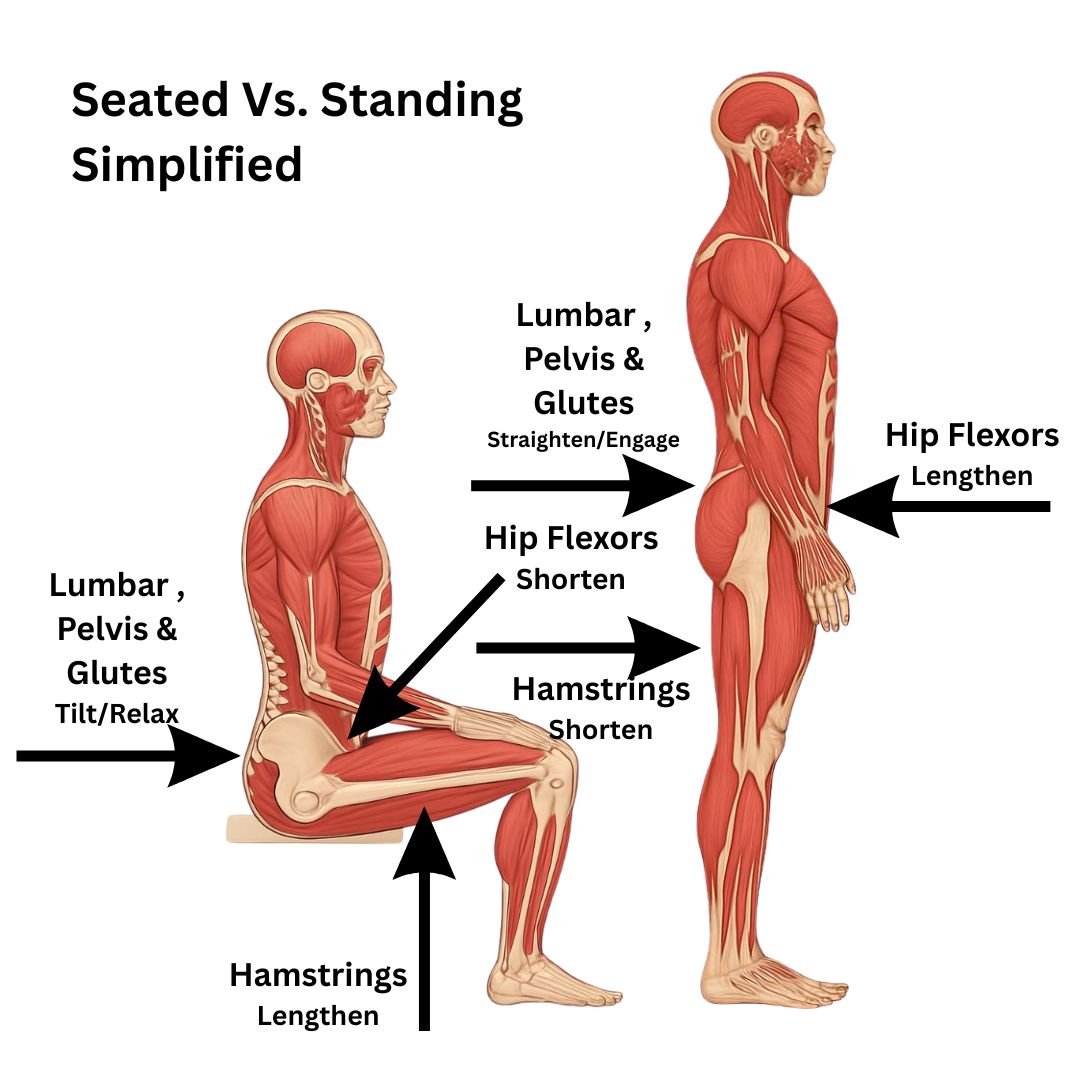
Hip flexors shorten in sitting
Your hip flexors are a group of muscles that help you lift your leg and fold at the hip. When you sit, they’re in a shortened position for a long time. Over time, many bodies adapt by feeling “stuck” when it’s time to lengthen them again.
That “stuck” sensation can show up as:
tightness in the front of the hips
an urge to arch the low back when standing
a low back that feels compressed or achy after sitting
Pelvic position + lumbar compensation
When hip extension is limited, the body still finds a way to stand tall and move forward. Often, it borrows movement from the nearest neighbor: the lumbar spine.
So instead of the leg moving cleanly behind you from the hip, the low back may:
arch more than it wants to
grip to create stability
feel “tight” as a protective response
“Tight” doesn’t always mean “stretch me”
This is a big one.
In yoga, we sometimes treat tightness like a simple equation: tight muscle = stretch it. But “tight” can mean:
shortened (needs mobility)- Move that area of your body
overworked (needs support elsewhere) - Build strength and stabilization around that area of your body
protective (needs safety + nervous system downshift) - Breathe into that space in your body - 4:6 breath
If your low back is tight because it’s doing too much stabilizing, stretching it harder can feel good for 30 seconds… and then the pattern returns.
The hip flexor/psoas connection (simple anatomy)
You’ll often hear people blame the psoas for everything. The truth is more nuanced—and more empowering.
The psoas is part of the iliopsoas, a deep hip flexor that has relationships with the lumbar spine region. When it’s overworking (or when the whole hip flexor group is overworking), your body may feel like it can’t fully stand tall without tension.
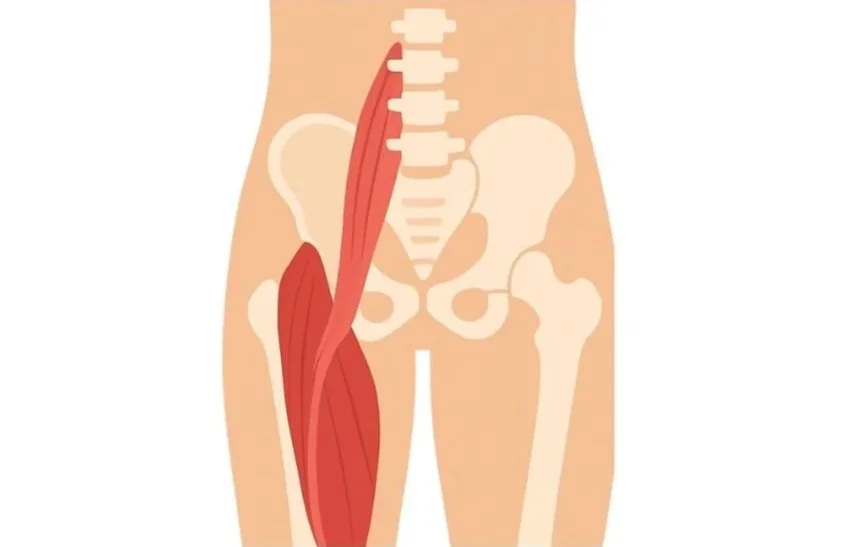
But here’s the key: we don’t need to “attack” the psoas. We want to:
give the hips a safe way to open into extension
strengthen glutes and deep core so the low back doesn’t have to grip
use breath to tell the nervous system, “you can soften now”
That’s yoga at its best: anatomy + awareness + compassion.
The nervous system piece (why stress makes it worse)
Have you ever noticed your low back feels tighter on busy days?
That’s not random.
When the nervous system is more activated (stress, rushing, too much screen time, poor sleep), the body often defaults to bracing:
jaw tightens
ribs lift and flare
hip flexors grip
low back stabilizes by tension
So yes, your low back tightness can be mechanical and nervous-system-driven. This is why a yoga practice that includes breath and slow control is often more effective than “just stretching.”
A 10-minute yoga reset (what yoga can do about it)
This is a gentle sequence you can do after sitting. Stay out of pain. Move slowly. If anything feels sharp or concerning, skip it.
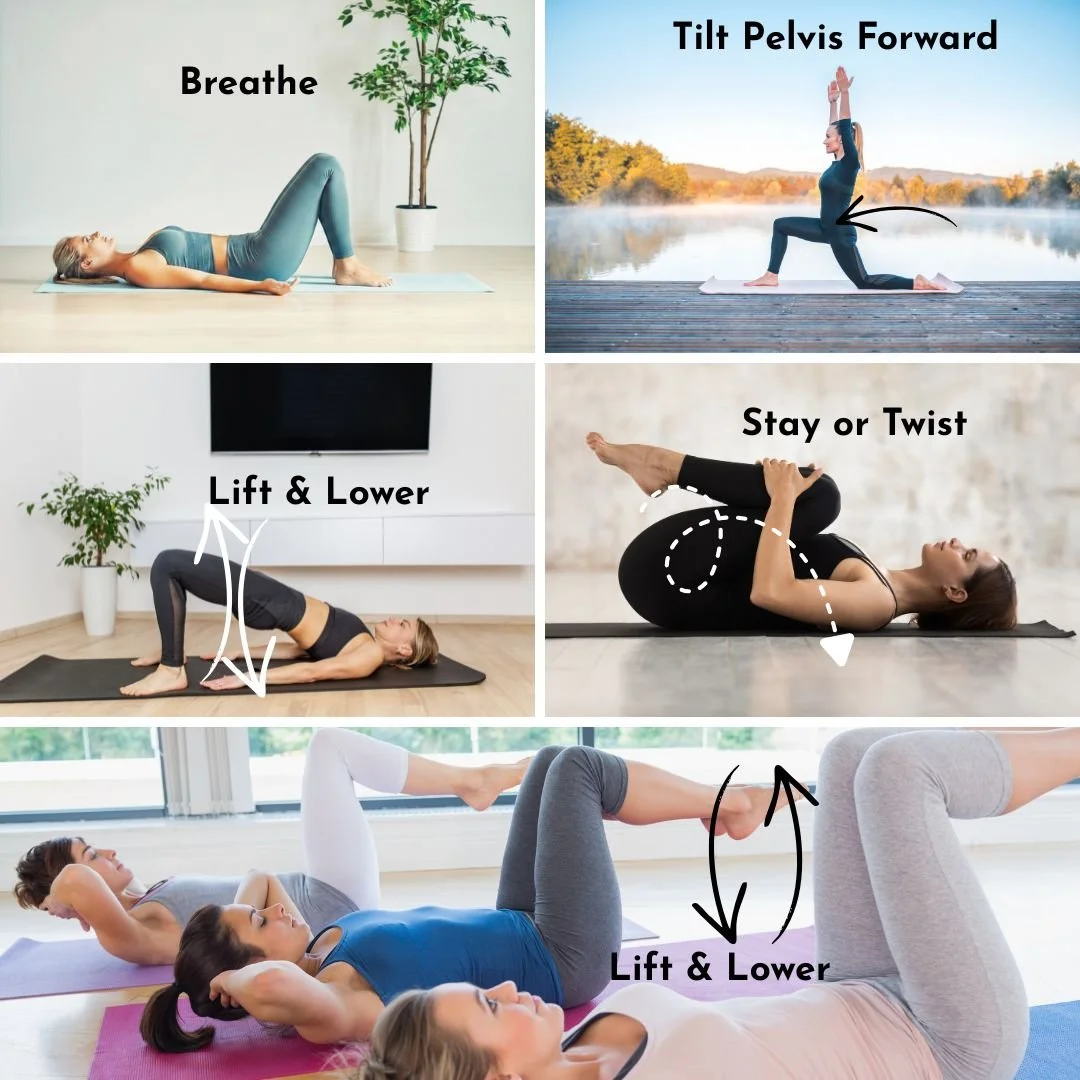
1) Constructive rest breathing (2 minutes)
Lie on your back with knees bent, feet on the floor (or calves on a chair).
Inhale through your nose.
Exhale slowly like you’re fogging a mirror.
Let your ribs soften down on the exhale.
Why it helps: downshifts bracing and gives your low back permission to release.
2) Low lunge hip flexor opener (2 minutes total)
Step your right foot forward into a low lunge (back knee down if you like). Keep it small.
Now the important part: posterior pelvic tilt (a gentle tuck) so you feel the stretch in the front of the left hip—not in the low back.
Take 3–5 slow breaths. Switch sides.
Why it helps: restores hip extension without dumping into the lumbar spine.
3) Glute bridge with slow exhale (2 minutes)
Feet on the floor, hip-width.
Exhale and lift hips slowly.
Inhale at the top.
Exhale and lower slowly.
Do 6–8 reps.
Why it helps: wakes up glutes so your low back doesn’t have to do all the work.
4) Dead bug or toe taps (2 minutes)
On your back, bring knees above hips.
Option A (toe taps): exhale, tap one foot down lightly, inhale back up. Alternate.
Option B (dead bug): add opposite arm reach if it stays stable.
Why it helps: builds deep core support with control (not gripping).
5) Knees-to-chest or supported twist (2 minutes)
Hug knees gently and breathe into the back body, or take a supported twist with a pillow under the knees.
Why it helps: creates a safe “closing” for the nervous system and the spine.
Common mistakes to avoid
If your low back is already feeling tight after sitting, these can sometimes reinforce the pattern:
forcing deep backbends to “open the hips”
yanking into forward folds to “stretch the back”
stretching the low back repeatedly without strengthening glutes/core
holding your breath during mobility work (this often equals bracing)
Yoga helps most when it’s balanced: breath + mobility + strength + awareness.
When to get personalized support
If your low back tightness is persistent, intense, or paired with symptoms that worry you, it’s wise to seek qualified in-person support. Yoga is powerful, but we keep it honest: this is education and practice, not medical treatment.
Go deeper with Yogi Institute
If you loved the blend of anatomy + inner awareness here, that’s exactly how I teach inside Yogi Institute.
Explore our trainings: https://www.yogiinstitute.com/ytt
Yoga 200 Online: https://www.yogiinstitute.com/yoga-200-online
Yoga 300 Online: https://www.yogiinstitute.com/yoga-300-online
Get the App (classes + community): https://www.yogiinstitute.com/get-the-app
Livestream practice: https://app.arketa.co/yogiinstitute
If you want, I can also tailor a short “desk-body” version of this sequence as a printable mini-guide to embed in the post (great for SEO time-on-page and saves).