If you’ve ever said, “My hips are so tight,” you’re in very good company. Tight hips are one of the most common reasons people come to yoga—along with low back tension, stiff shoulders, and that general feeling of being a little stuck in your own body.
And here’s the compassionate truth I want you to hear first:
You’re not broken.
Your body is communicating.
Sometimes “tight” is a simple mobility limitation. But very often, tight hips are a strategy—your nervous system and your stabilizers doing their best to keep you feeling safe and supported.
Quick definition
“Tight hips” usually refers to a sensation of restriction, stiffness, or pulling around the hip joint (front hip flexors, outer hips/glutes, inner thighs, or deep in the socket). It can be caused by muscle tone, protective bracing, limited joint motion, or nervous system stress—not just “short muscles.”
Let’s break it down in a way that’s anatomy-forward, grounded, and still deeply yoga.
Why your hips can feel tight even if you stretch
A lot of us were taught: tight = short, so stretch it.
But in real bodies, “tight” can also mean:
Protective tension (your system guarding a joint)
Low stability (your body bracing because it doesn’t trust support)
Stress tone (your baseline nervous system state is elevated)
Habitual posture (sitting patterns, standing patterns, breath patterns)
Protective tension vs. short muscles
If your nervous system senses instability—whether physical or emotional—it often increases muscle tone to create support. This is not your body being dramatic. It’s your body being intelligent.
So if you’re stretching your hip flexors daily and still feel tight, it might not be because you “need more stretching.” It might be because your system is asking for better signaling of safety and more integrated strength.
Your hips don’t work alone
The hip joint is influenced by:
Pelvis position (anterior/posterior tilt, rotation)
Lumbar spine mechanics
Ribcage + breath
Foot/ankle input
Nervous system state
That’s why hip work that includes breath, core, and gentle strength often creates more lasting change than long, intense holds.
The anatomy: what’s actually around the hip joint
Your hip is a deep ball-and-socket joint surrounded by powerful tissues. When people say “tight hips,” they might mean:
Hip flexors (front of hip): iliopsoas, rectus femoris
Glutes (back/outer hip): glute max/med/min
Deep rotators (deep in the socket): piriformis + friends
Adductors (inner thigh): often overlooked, often involved
Fascia: connective tissue that transmits tension and support
Here’s a key yoga takeaway:
Your hips are designed for both mobility and stability.
When one is missing, the other often gets hijacked.
Mobility vs. stability (and why both matter)
This is one of my favorite re-frames for “tight hips.”
If your hips feel tight, you might assume you need more mobility. But sometimes the missing ingredient is stability—especially around the pelvis, deep core, and glute med.
When more stretching can backfire
If you’re already living in a body that’s:
hypermobile,
fatigued,
stressed,
or bracing unconsciously…
…then deep stretching can feel relieving in the moment, but leave you feeling even more unstable afterward. Your system may respond by tightening again—because it still doesn’t feel supported.
Signs you may need stability more than mobility
You might benefit from more stability work if:
you feel “loose but tight” (weird combo, but real)
you get pinching in deep hip stretches
your low back takes over in lunges/backbends
you feel wobbly in single-leg balance
stretching helps briefly, then tightness returns fast
A gentle “tight hips” reset (10–12 minutes)
This is not a medical protocol—just a yoga-informed, nervous-system-friendly sequence you can explore. Keep it small. Keep it kind. Let your breath lead.
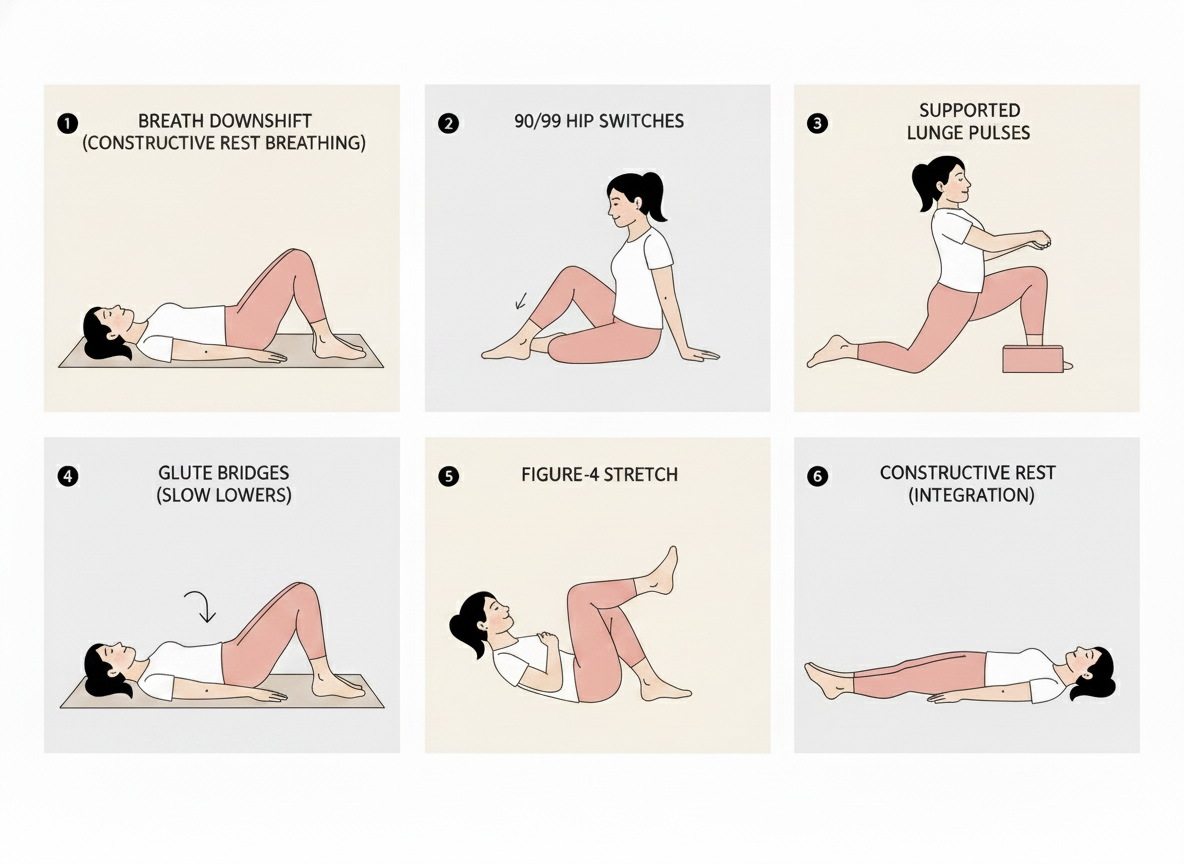
Step 1 — Downshift with breath (1 minute)
Lie on your back, knees bent, feet on the floor.
One hand on belly, one on ribs.
Inhale through the nose.
Exhale slowly like you’re fogging a mirror (or softly through the nose if that feels better).
Aim for: longer exhale than inhale.
Step 2 — 90/90 hip switches (2 minutes)
Sit on the floor (or on a folded blanket). Bring legs into a gentle 90/90 shape (both knees bent).
Slowly switch side to side—small range is perfect.
Focus on: smoothness, not depth.
Step 3 — Supported lunge pulses (2 minutes)
Come into a low lunge with hands on blocks or on your front thigh.
Instead of sinking and holding, try tiny forward/back pulses.
Think: “I’m teaching my hips that movement is safe.”
Step 4 — Glute bridge with slow lowers (2 minutes)
Lie on your back, feet hip-width.
Lift into bridge on an exhale.
Lower slowly for a count of 3–4.
This is one of the simplest ways to tell your hips: you are supported from behind.
Step 5 — Figure-4 stretch (optional, 1–2 minutes)
Cross ankle over opposite thigh. Keep the foot flexed gently.
If you feel pinching in the front of the hip, back out and make the shape smaller.
Step 6 — Constructive rest integration (1–2 minutes)
Feet wide, knees knock in. One hand on heart, one on belly.
Ask quietly:
“What does ease feel like right now—without forcing it?”
That question is yoga.
How to practice safely (no forcing, no fixing)
A few grounded guidelines:
Green light sensations: mild stretch, warmth, steady breath, a sense of “opening” over time
Yellow light: sharp pulling, numbness/tingling, breath holding, pinching in the front of the hip
Red light: pain, catching, instability, or anything that feels alarming
And always: if you want truly individualized guidance, it’s okay to get support from a qualified professional who can assess your body.
Want structure + support?
If you love anatomy-forward learning with a spiritual backbone—this is exactly what we teach inside Yogi Institute.
In our Yoga 200 you learn foundations of alignment, breath, and functional movement patterns you can apply to real life.
In Yoga 300 / 500, we go deeper into anatomy, intelligent sequencing, and teaching skills—so you’re not just doing shapes, you’re understanding bodies.
And inside the Yogi Institute App, you can explore practices that build strength, mobility, and nervous system steadiness—without the pressure to “perform” yoga.
You deserve a practice that feels like coming home.
5 FAQs (concise answers)
Why are my hips tight even though I stretch every day?
Tightness can be protective muscle tone, stress response, or stability needs—not just short muscles.Is it bad to stretch hip flexors a lot?
Not inherently, but long/deep holds can backfire if your pelvis and core aren’t supporting the range.What’s better for tight hips: yoga or strength training?
Often both. Gentle mobility + targeted stability (glutes/core) tends to create the most sustainable ease.Why do I feel hip pinching in deep poses (like pigeon)?
Sometimes it’s joint position, pelvic angle, or your anatomy. Back out, use props, and choose shapes that feel spacious.How long does it take to improve hip mobility?
It varies. Consistent, gentle practice that includes breath + stability usually changes how hips feel faster than forcing depth.
Internal link ideas (teacher trainings/app/office hours)
Link to The App: https://www.yogiinstitute.com/the-app
Anchor idea: “practice hip mobility + stability inside the Yogi Institute App”Link to On-Demand Library: https://www.yogiinstitute.com/on-demand-library
Anchor idea: “try a gentle hips + low back reset”Link to Yoga 200 Online: https://www.yogiinstitute.com/yoga-200-online
Anchor idea: “learn anatomy + alignment foundations in Yoga 200”Link to Yoga 300 Online: https://www.yogiinstitute.com/yoga-300-online
Anchor idea: “go deeper into functional anatomy + intelligent sequencing”Link to Yoga 500 Online: https://www.yogiinstitute.com/yoga-500-online
Anchor idea: “build a complete, anatomy-informed path (200+300)”Link to Livestream (and mention office hours/community live support if relevant): https://app.arketa.co/yogiinstitute
Anchor idea: “join us live for support and real-time guidance”