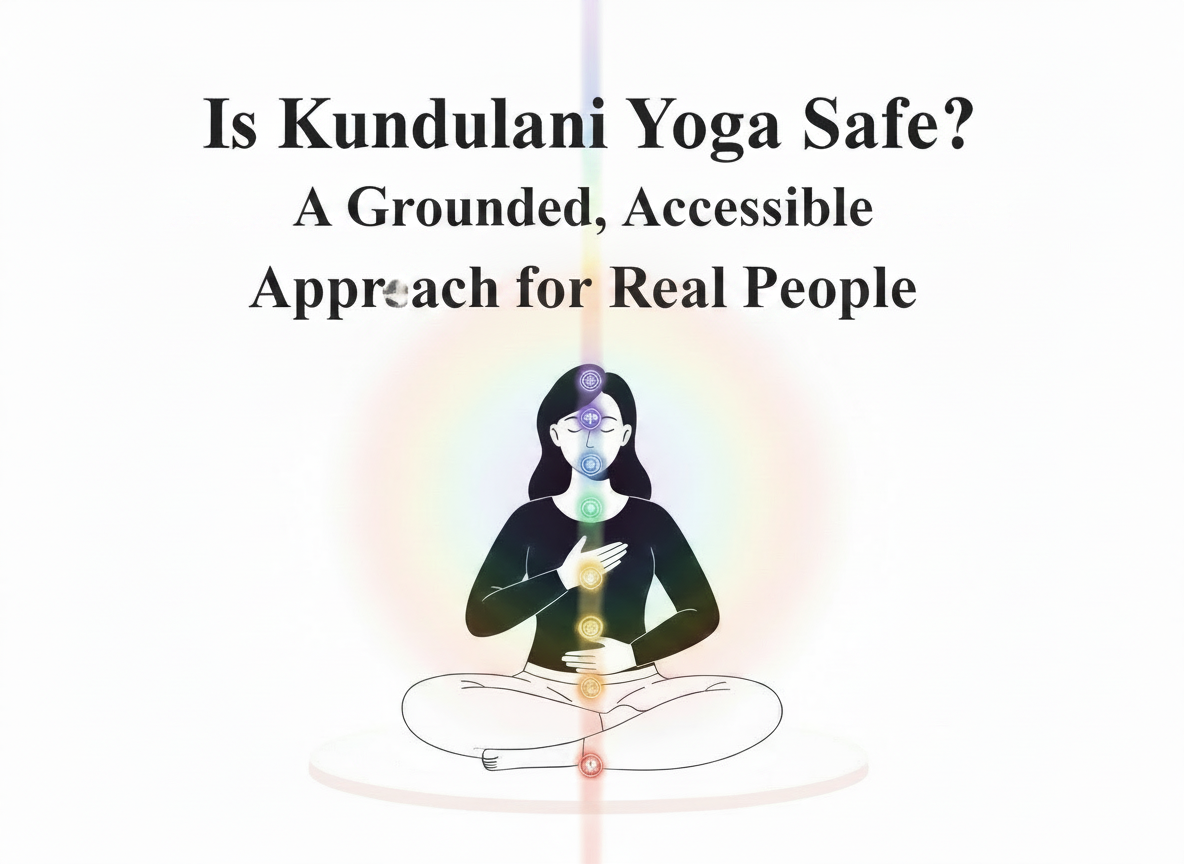
If you’ve been curious about Kundalini Yoga, you’re not alone. “Kundalini yoga for beginners” is one of the most consistently searched phrases in the yoga world—and I think that’s because people are craving something specific:
A practice that feels spiritual and practical.
A practice that helps you feel energy and clarity without needing to be “perfect.”
A practice that meets real life—stress, emotions, busy schedules—and offers a way back to center.
But if you’ve also heard scary stories online, I get it. Kundalini can sound mysterious, intense, or even unsafe depending on who’s talking about it.
So let’s make this simple, grounded, and accessible.
Quick Definition
Kundalini Yoga is a style of yoga that combines breathwork, repetitive movement (kriya), mantra, meditation, and rest to support energy, awareness, and nervous system balance. In a beginner-friendly approach, the goal isn’t to force an “awakening”—it’s to build steadiness, clarity, and connection from the inside out.
Why people search for Kundalini Yoga (and what they’re really wanting)
Most people don’t search “kundalini yoga” because they want a workout.
They search because they want:
energy that feels clean (not anxious)
emotional release that doesn’t feel like a breakdown
a spiritual practice that isn’t vague
a sense of purpose and inner guidance
tools for stress that actually work
Kundalini has a reputation for being powerful because it’s not just physical. It works with breath, attention, and rhythm—three things that directly influence your nervous system and your inner state.
And that’s where the magic is: not in hype, but in practice.
What happens in a Kundalini Yoga class?
Different teachers and lineages vary, but a classic Kundalini class often includes:
Breathwork (pranayama)
Kundalini uses breath to shift state. Some techniques are energizing, some are calming. In an accessible approach, we keep it nervous-system-friendlyand avoid pushing intensity.
Kriya (movement + posture)
A kriya is a set sequence—often repetitive—that builds focus and creates a specific effect. Think: spinal movement, core work, arm positions, rhythmic motion.
Repetition is part of why Kundalini can feel meditative. Your mind stops negotiating and starts listening.
Mantra + sound
Mantra can be incredibly grounding. It gives the mind a place to rest. If mantra isn’t your thing, you can still practice Kundalini principles with breath + movement + meditation.
Meditation + rest
Kundalini isn’t complete without integration. Rest is where your system absorbs the practice.
Kundalini myths that scare people away
Let’s talk about the big ones—without drama.
Myth #1: “Kundalini is dangerous.”
Any powerful practice can become destabilizing if it’s taught without grounding, consent, or pacing. But Kundalini itself isn’t inherently “dangerous.”
A safer frame is: your nervous system matters. A good teacher respects that.
Myth #2: “You’ll have a spontaneous awakening.”
Some people use the word “awakening” to describe big emotional shifts, spiritual insight, or increased sensitivity. But you don’t need to chase that—and you definitely don’t need to fear it.
In my world, we practice for steadiness first. If something opens, we meet it with support and grounding.
Myth #3: “It’s only for super spiritual people.”
Nope. Kundalini can be deeply spiritual and very practical. You can come exactly as you are—busy, skeptical, tender, curious, healing, hopeful.
A more open, accessible approach to Kundalini
At Yogi Institute, I love Kundalini because it’s transformational—but I teach it in a way that’s human.
Here’s what that means:
Nervous system first
If your system is already stressed, we don’t pile on intensity. We build safety through breath, pacing, and choice.
Consent-based intensity
You always get options:
smaller range
slower pace
fewer rounds
rest breaks
“try it without breath retention” (if that’s not supportive)
No forcing breath or emotion
If a practice brings emotion up, that’s not “proof it worked.” It’s information. We stay grounded, we breathe, we give it space—without turning it into a performance.
Beginner-friendly Kundalini practice (8–12 minutes)
This is a gentle introduction—no medical claims, no pressure. If anything feels dizzying or too activating, pause and return to normal breathing.
1) Centering + long-exhale breath (2 minutes)
Sit comfortably. One hand on belly, one on heart.
Inhale through the nose.
Exhale slowly—slightly longer than your inhale.
Let your jaw soften. Let your shoulders drop.
2) Gentle spinal movement (3 minutes)
Come to a comfortable seat.
Option A: Seated Cat/Cow (hands on knees)
inhale: lift chest, arch gently
exhale: round spine softly
Keep it small and smooth.
3) Simple arm movement + breath (2 minutes)
Bring arms out to the sides like a cactus (or keep hands on thighs if shoulders are sensitive).
Inhale: open chest
Exhale: hug arms in (like you’re holding yourself)
Repeat slowly. This is self-regulation in motion.
4) Mantra meditation (optional) (2–3 minutes)
If mantra feels supportive, try a simple phrase in English: “Sat Nam” (often translated as “truth is my identity”)
Or use: “I am here.”
Silently repeat on each exhale.
5) Integration rest (1–2 minutes)
Lie down or stay seated.
Notice: what feels different now?
Not “better.” Just different.
That’s awareness.
How to choose a Kundalini class (green flags)
If you’re new, look for:
options and modifications
grounding language (not fear-based)
encouragement to rest
no pressure to push breath intensity
respect for your pace and boundaries
You deserve a teacher who helps you feel empowered—not dependent.
Want to go deeper with support?
If you’re craving a Kundalini path that’s structured, accessible, and rooted in real practice (not hype), you’re invited to join us.
Explore Kundalini 75 here: https://www.yogiinstitute.com/kundalin-75
Practice inside the Yogi Institute App: https://www.yogiinstitute.com/the-app
Kundalini On-Demand Library: https://app.arketa.co/yogiinstitute/on-demand/uTdjpdK3ponKGHtobFJz
Join us on Livestream: https://app.arketa.co/yogiinstitute
Kundalini, at its best, is not about forcing something to happen.
It’s about remembering what’s already true—beneath the noise.
6) 5 FAQs (concise answers)
What is Kundalini Yoga, in simple terms?
A mix of breath, movement sequences (kriya), mantra, meditation, and rest to support energy and awareness.Is Kundalini Yoga good for beginners?
Yes—when it’s taught with options, grounding, and nervous-system-friendly pacing.Do I have to chant in Kundalini Yoga?
No. Mantra is optional. You can focus on breath and movement if that feels better.Will Kundalini “awaken” something in me?
People experience it differently. A grounded approach prioritizes steadiness and support over chasing big experiences.How often should I practice Kundalini Yoga?
Start small—1–3 times/week is plenty or jump right in 7 days a week... The most important thing is that youy listen to your own inner guidance AND if you need support that you reach out. Know that lead instructor Jill Enticknap is always there to support your journey and you can email jill@yogiinstitute or use the app to contact her any time. Consistency matters more than intensity.
Internal link ideas (teacher trainings/app/office hours)
Kundalini 75: https://www.yogiinstitute.com/kundalin-75
Anchor: “beginner-friendly Kundalini certification + community”The App: https://www.yogiinstitute.com/the-app
Anchor: “practice Kundalini-inspired classes inside the app”Livestream: https://app.arketa.co/yogiinstitute
Anchor: “join us live for guided practice and support”Kundalini Yoga 200 Online Info/Registration: https://app.arketa.co/iframe/yogiinstitute/series/00Posioa22qlabLeoGCn
Anchor: “build strong foundations in breath, alignment, and teaching”