Yoga for Low Back Pain Relief: Anatomy-Informed Moves That Actually Help
If you’ve ever felt that familiar low back “grab” after a long day—sitting, driving, working, or even after a yoga class—you’re not alone. And here’s the compassionate truth: your body isn’t failing you. Most of the time, your low back is doing its best to stabilize and protect you.
In my experience teaching (and studying functional anatomy for years), low back tension often isn’t solved by stretching harder. It’s solved by breathing better, organizing the pelvis, and giving the hips and ribcage the mobility they’ve been asking for.
Low back tension is a feeling of tightness, stiffness, or soreness in the lumbar area that can be influenced by posture, stress, movement habits, and how your nervous system perceives safety. Yoga can support comfort by improving breath mechanics, mobility, and stability—without forcing range of motion.
Why your low back feels tight (and why stretching isn’t always the answer)
When the low back feels tight, we often assume it needs more flexibility. But “tight” can also mean guarded. The lumbar spine is designed for stability with some movement—not endless bending.
The “too much sitting” pattern: hips + thoracic spine + breath
If you sit a lot, your hips may live in flexion (think: hip crease shortened), your glutes may under-participate, and your upper back (thoracic spine) may stiffen. When hips and thoracic spine don’t move well, the low back often tries to compensate.
When flexibility isn’t the issue: stability and nervous system tone
Sometimes the low back tightens because your system is seeking stability. Stress, poor sleep, and mental load can increase overall muscle tone. That’s not “in your head.” It’s physiology: the nervous system is always scanning for safety.
So our practice becomes twofold:
Mechanical support (pelvis, hips, ribs)
Neurological support (breath, pacing, permission)
The anatomy lens: 3 areas to support for a happier low back
1) Pelvis + deep core (diaphragm, pelvic floor, TVA)
Your diaphragm isn’t just for breathing—it’s part of your core system. When breath is shallow and high in the chest, the low back can feel like it’s carrying the load.
Try this cue: “Let the breath widen the ribs and soften the belly.” Not a push—more like a gentle expansion.
2) Hips (especially hip flexors + glutes)
Hip flexors that feel “tight” often need both length and strength. Glutes that feel “lazy” often need better timing. When these two aren’t cooperating, the low back may try to help with movements it wasn’t meant to dominate.
3) Thoracic spine + ribs (rotation and breath mechanics)
A stiff ribcage can make the lumbar spine over-rotate or over-extend. Gentle thoracic mobility can be a game-changer for back comfort.
A gentle yoga practice for low back tension (15–25 minutes)
This is a supportive sequence you can do 3–5 times per week. Move slowly. If anything increases sharp pain, numbness, or tingling, pause and seek guidance from a qualified professional.
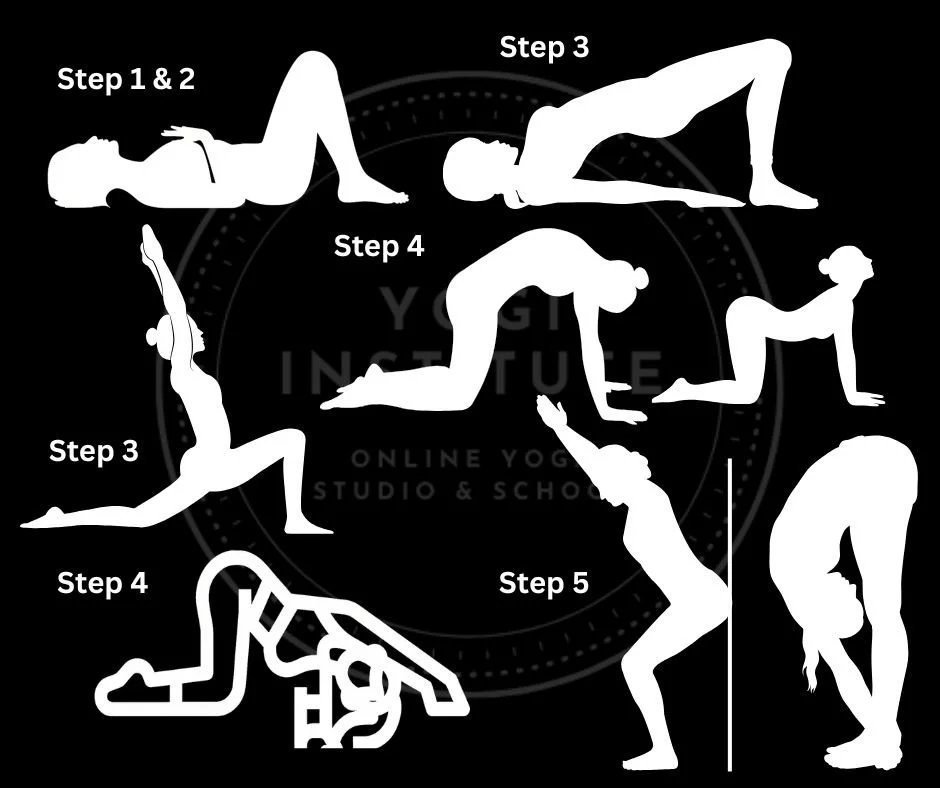
Step 1: Downshift your nervous system (2 minutes)
Constructive Rest (on your back, knees bent, feet on floor)
Place one hand on belly, one on ribs.
Inhale through the nose for a comfortable count.
Exhale slowly, as if fogging a mirror (soft, controlled).
Feel the back of the ribs melt toward the floor.
Inner practice: On each exhale, silently repeat: “I am safe enough to soften.”
Step 2: Pelvic mapping + core support (3 minutes)
Pelvic Tilts
Still on your back, gently rock the pelvis: small arch, then small flatten.
Keep it subtle—this is about awareness, not force.
Then add Heel Slides (optional)
Keep pelvis steady as one heel slides away and back.
If the low back grips, make the movement smaller.
Step 3: Hip flexor + glute balance (6–8 minutes)
Bridge Pose (supported strength)
Feet hip-width, press evenly through heels and big toes.
Lift hips only as high as you can keep ribs soft (no rib flare).
Hold 3 breaths, lower slowly. Repeat 5–8 times.
Low Lunge (gentle hip flexor opening)
From hands and knees, step one foot forward.
Keep a small posterior pelvic tilt (think: tailbone heavy).
Breathe into the front of the hip.
5–8 breaths each side.
Tip: If you feel it in the low back, reduce depth and bring hands to blocks.
Step 4: Spinal mobility without yanking (4–6 minutes)
Cat–Cow (slow and breath-led)
Inhale: broaden collarbones, lengthen spine.
Exhale: round gently, feel the belly draw in naturally.
6–8 rounds.
Thread the Needle (thoracic rotation)
From tabletop, slide right arm under left.
Keep hips stacked; rotate from ribs.
5 breaths each side.
Step 5: Integrate with a simple standing pattern (3–5 minutes)
Supported Chair Pose at the Wall
Stand with back against a wall, feet a step forward.
Slide down slightly (not deep).
Feel: ribs stacked over pelvis, weight through mid-foot.
3–5 breaths.
Finish with Standing Forward Fold (micro-bend)
Bend knees generously.
Let the spine drape.
Hands to blocks or thighs.
5 slow breaths.
What to avoid (common yoga mistakes for low backs)
Forcing deep forward folds with locked knees
Over-arching in backbends without core/rib support
Skipping breath and rushing transitions
Chasing sensation instead of building stability
A helpful mantra: “Comfortable and steady beats impressive and strained.”
The inward journey: pain, protection, and compassionate attention
Here’s where science and spirituality meet in a very real way.
Your nervous system learns from your attention. When you approach your back with fear, urgency, or frustration, the body often tightens. When you approach with curiosity and patience, the system receives a different message.
A science-meets-spirit reframe
Instead of “What’s wrong with me?” try:
“What is my body protecting?”
“What support is missing?”
“Can I meet this moment with kindness?”
A short closing meditation (60 seconds)
Sit or lie down. One hand on heart, one on belly.
Inhale: feel the body receive breath.
Exhale: feel the body release effort.
Whisper internally: “May I be gentle. May I be steady. May I trust the process.”
Next steps with Yogi Institute
If you want structure, guidance, and a supportive community (with anatomy that actually makes sense), you’re in the right place.
Explore our Yoga Teacher Trainings (200/300/500) if you want a deep, confidence-building foundation.
Join the Yogi Institute App for consistent practices you can repeat and progress.
Come to weekly Office Hours if you want real-time support and personalized Q&A.
FAQs
Is yoga good for low back pain? Yoga can be supportive for many people by improving breath, mobility, and strength. Choose gentle, well-cued practices and avoid forcing range of motion.
What yoga poses should I avoid with a sensitive low back? Often: aggressive forward folds with straight knees, deep backbends without core support, and fast transitions that create strain.
How often should I practice? Try 15–25 minutes, 3–5 times per week. Consistency usually matters more than intensity.
Why does my back feel tighter after stretching? Sometimes the nervous system responds to stretching as a threat and increases guarding. Add breath and stability work, and reduce intensity.
What if I feel tingling or numbness? Pause the practice and consult a qualified healthcare professional. Those symptoms can indicate nerve involvement and deserve individualized assessment.